
Teaching & research Research
Research · MEEA 2026, CairoPalestine's economy under military occupation, 1995–2025.
The recorded presentation of Structural Economic Fragility Under Prolonged Military Occupation: Labor Market Distortions and Household Welfare in Palestine, 1995–2025, given at the Middle East Economic Association 22nd International Conference, hosted by the AUC Onsi Sawiris School of Business at The American University in Cairo, on October 20, 2026.
- 15minutes
- 30years of PCBS microdata
- 3Mhousehold records
Fifteen minutes, thirty years of data.
Nothing loads from YouTube until you press play. The same recording is on YouTube if you would rather watch it there.
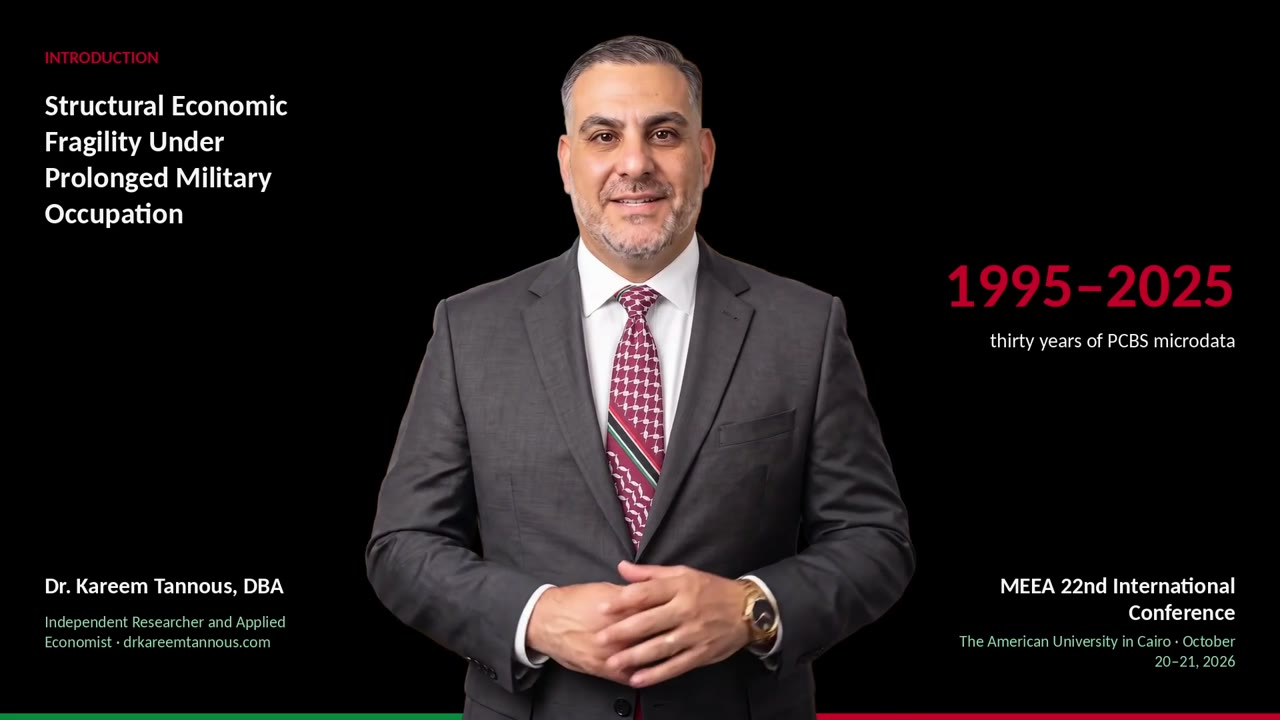
Delivered through a licensed AI avatar and voice of Dr. Tannous, following the talk as given at the conference. The research, the words and the results are his.
An employment rate is an abstraction until it is someone's morning.
Thirty years of Palestinian labor-force microdata, nearly three million records, say three things.
-
1
The deepest fragility is revocable access.
The dominant structural channel is Palestinian workers' access to the Israeli labor market, access that can be withdrawn by administrative decision, and was, in 2000 and again after October 2023. Inside the data, holding that access is good for the worker who has it; what hurts is that it can be taken away.
-
2
There is no long-run equilibrium.
At annual and quarterly frequency alike, the economy is not converging toward anything. It absorbs shock after shock with no anchor, and recovers about a third of each shock within a year. The present arrangement is not a transition that will settle; the data say it is a condition that repeats.
-
3
Two conflict shocks worked differently.
The 2014 escalation cut Gaza employment by about four percentage points, a result that survives every robustness check. The blockade reshaped who gets to take part in working life at all, with women and young people disappearing from the ledger.
What follows
The data do not choose a political arrangement. They set the examination: whichever arrangement ends revocable labor access, gives the economy shock absorbers, and reopens the participation margin, passes. Indefinite military occupation fails it.
With thanks
To the Middle East Economic Association for accepting the paper; to the AUC Onsi Sawiris School of Business and The American University in Cairo for hosting; to the conference organizers Dr. Mahmoud Haddad and Dr. Shireen Alazzawi; and to the Session 5 chair, Dr. Dina Abdel Fattah.
Roots
Why this research: the family's path from Al-Lydd and Yaffa is on the home page.